I once had a union official lodge a complaint that we were not treating everyone in the factory the same and that it had to stop. I told him that if he insisted, at my next “all hands” meeting I would announce that the union told me to treat them all poorly. The reason – the union insists that I treat everyone equally and since there are people who don’t behave responsibly, I had to hold them all to the lowest common denominator.

The union official eventually backed down. He knew that I would always uniformly apply contract language and he eventually understood that treating people fairly is not the same as treating them equally. Our factory ultimately went from a long line of employees waiting to file a grievance, to no grievances; and from worst to first in employee satisfaction, all while delivering outstanding performance. [For more, see The Factory Case Study ]

The 5-85-10 Rule

The concept of “fair is not equal” is not new. However, I needed more than a quote from some anonymous person to have the courage and conviction to stand up to the pressure. The proof came to me in the form of what I call the “5-85-10 Rule”.

In my first executive General Manager assignment, I asked my management team to step away from their day-to-day assignments every quarter to rate all of their employees on a scale from one to ten. (The highest number represented the best possible performance.) Individual performance reviews for union and non-union employees had never been conducted in this particular factory before. But we knew these ratings would help us monitor performance trends, identify workers who should be mentored or terminated, and improve overall productivity.

The reviews would also help people understand exactly where they stood in the eyes of their managers. And that’s something everybody should know in the workplace, since it has a powerful impact on job security and emotional health.

When we completed our first review, we discovered the following:

  • Five percent of our employees were candidates for termination.
  • Ten percent were star performers.
  • The rest—eighty-five percent—were giving an acceptable effort. But we all believed they could do much better.
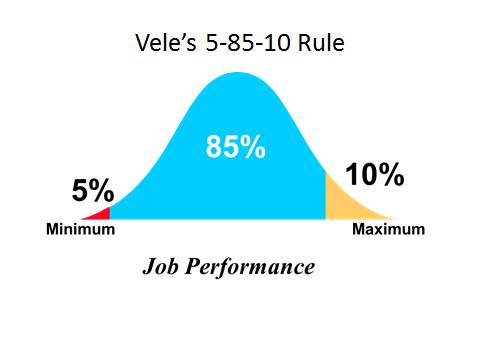
With minor variations, this basic breakdown was confirmed every quarter. And it made me re-think my ideas on organizational performance. Here’s where I ended up.

  • The best employees are the ultimate self-starters: They are going to do a great job no matter what. And there is very little management can do to dramatically increase their contribution.
  • Unfortunately, there isn’t much chance of getting more from the slackers in the bottom five percent. The best thing to do is to monitor them closely, set clear expectations for improvement, and if they fall short, get rid of them as soon as you can (of course in accordance with the union contract!).
  • But the people in the middle—the largest group—represent a swing state. They can underperform or outperform depending on the work environment and the quality of leadership in the organization.

This also seemed to validate what I read long ago about a researcher who discovered that people can hold onto their jobs by working at anywhere from twenty to ninety percent of their ability.

You can quibble about those numbers. But we all know that there is a huge range of performance in the workplace. And one of the most important tasks for any leader is to move as many people as possible into the maximum performance zone. So if you’re trying to improve the performance of an organization, the people in the 85 Percent Club are the people who have to raise their game.

So how do you do it? What’s the lever that will move the people in the middle into a higher gear?

The Tipping Point in Performance

As a leadership team, we were faced with a defining moment: “is it fair to treat the 10% “stars” the same as the 5% “slackers” and what was the impact on the 85% that were watching the drama play out?” And you better believe that everyone is watching. They are deciding whether to follow you or wait you out.

Our first decision was to hold people accountable for their actions and decisions. In other words we started to draw distinctions in how we treated the “slackers” and the “stars”.

    • Everyone can see when people are abusing the system. If the leadership doesn’t hold people accountable, the organization concludes that the leaders are blind, weak, or stupid.
    • If you don’t treat the “slackers” and “stars” differently, the 85% resort to doing the least amount of work possible to not get fired. After all, the pay is the same and they make a conscious decision to just put in their time and go home.

We then made a commitment to create an empowered environment. As leaders, we had to delegate responsibility and make sure people have the resources and coaching they need to do their jobs.

    • We started by focusing on the “stars” – giving them more air time, putting them in leadership positions, and essentially treating them like the high performers that they were.
    • The 85% wanted to be treated like “stars” and they wanted to distance themselves from the “slackers” and potential termination. The result was a huge shift in performance and an improvement in employee satisfaction.

The Looming Battle for Talent – Implications for the Future

When the economy is humming, the war for talent goes into overdrive. And then companies go out of their way to keep people satisfied and fully engaged.

But when there’s a protracted economic downturn, the most valuable resource in business turns into a commodity. Work piles up on everyone’s plate. Rewards and recognition vanish. And companies even cut back on the most important vehicle for leadership…employee communications.

In essence, people are taken for granted because they are easily replaced.

As the quality of life in the workplace tanks, dissatisfaction spreads like a virus. And sooner or later productivity takes a hit. Meanwhile, a lot of talented people (ie the 10%) get ready to jump ship at the first opportunity.

As the leader, it’s your responsibility to win the hearts and minds of your people. And you can do that by holding the 5% accountable and developing an empowering, entrepreneurial culture and a never-ending, leader-driven communication campaign for everyone else.

And that’s fair.

16 responses to “Fair is not Equal: How to win the hearts and minds of your people”

  1. Donella Pogue

    Brilliantly stated.

    1. Donella – Thanks for your kind words and for signing up to receive updates of my blog.

      About Donella Pogue: Donella is a Sales Manager at Pictometry International in Rochester, NY

  2. Reblogged this on EHS Safety News America and commented:
    Thought provoking article and a unique way to grade e your employees.

    1. Sandra Quinlan

      Thank you for sharing your thoughts and experience. I totally agree with your observations around what happens when we have a change in the econemy and people contract in fear.

      1. Sandra, thank you for your comment. As the economy recovers, the companies / managers that have treated people poorly during the downturn will begin to suffer as their good employees are presented with better opportunities.

  3. Mike K.

    I saw similar models before.
    I also agree on the underlying premise of empowering “stars” and holding “slackers” accountable – if that is really the case.

    However, as with any statistic, you must be very careful on how you tactically resolve this matter.

    If, for instance, each quarter you would fire the 5% slackers, then you quickly run into the perverse incentive that 100% of the staff will be more busy framing others as slackers than actually doing any work – and the emerging “stars” may just be the framing experts, not the subject matter experts…

    Your measure of capacity must always be the positive ability to execute, not something negative like time/money wasted or failures.

    1. Michael, thank you for your comment. As you note, the key to improving performance is to focus on positive capability.

      In terms of dealing with the 5%, I am not endorsing the firing of the bottom 5% en masse. I have worked at Bank of America where they annually “top grade” the company by terminating 5-10% of the organization, similar to past practices at General Electric. I found that this approach resulted in ‘lazy’ management and the type of ‘framing’ you mention.

      What I am endorsing is that Management must be pro-active in dealing with poor performance. Termination is not the goal or the tool of choice. Managers must first identify the poor performers and then take actions to move them up or out of the organization. My experience with this approach has been that performance improves and termination is rarely the end result.

  4. Excellent insights, Vele. I touch on a similar topic In my new business fable, “Getting to the Heart of Employee Engagement: The Power and Purpose of Imagination and Free Will in the Workplace.” One of the problems with holding the 5% accountable is that it’s hard to single them out in terms of policies, practices, systems, processes, etc. So organizations wind up creating control systems that affect everyone else, e.g. notes from the doctor, verification of attending funerals, and lots of other similar things that undermine the spirit of a trusting, empowered workplace. One way to deal with that is to create a culture of employee-owned, constructive accountability. Employees need to feel not just okay, but even responsible, for calling out other employees who abuse the system. It’s important, though, that they do it constructively instead of critically. Even most abusers want to do a good job and thought well of by their co-workers. If their co-workers approach them collectively and call them on the abuse and also tell that person how they’re valued and how much the team counts on them, it can have a much greater impact than a boss doing it. It also has more lasting power because bosses can see the everyday little infractions that co-workers can. You can check out more on my book by going to our website at http://www.landesassociates.com or sending me an e-mail at leslandes@landesassociates.com

    1. Les, thanks for your comment. You are right that it is hard to hold the 5% accountable and that many managers revert to the tactics you mention. I made that mistake right out of college supervising a 3rd shift assembly line. I had a tough group and began to insist on doctors notes to keep people from taking advantage of the system. When a top employee had a migraine and I wouldn’t let her off the assembly line because she didn’t have a note, it took another employee to set me straight on “fair is not equal”.

      So while it is tough, managers must manage. A few years later in another factory, but this time as a plant manager, I had a few employees skip out of an all hands meeting. Even though many in the factory thought I should have everyone sign in in the future to catch the culprits, I resisted because I didn’t want to treat all of them like ‘criminals’ when it was up to me and my team to find the few. This earned the factory’s respect and they began to hold everyone to a higher standard, as you suggest.

      About Les Landes: Les is the founder and president of Landes & Associates, A firm that aligns marketing communications with employee engagement. He is the author of numerous articles with areas of expertise that range from communication to marketing to organizational development to employee engagement and more.

  5. […] doesn’t work. The people that you are trying to lead can see right through the façade. And believe me, they are always watching.  Since each decision has an impact on the team, they try to make sense of your decisions and they […]

  6. […] In that defining moment, I began to form who I was as a leader and learned that “fair is not equal”. […]

  7. […] Develop a realistic understanding of the performance curve in the workplace (Vele’s 5-85-10 Rule) • Design a cultural transformation strategy to boost productivity (How to build an Innovative […]

  8. […] provide more detail in my “Fair is not equal” post, but we rated everyone because we believed that treating everyone alike was not the same as […]

  9. […] management and leadership skills required to successfully run a company. ( I mentioned an article Fair is Not Equal article discussing how manage your […]

  10. […] In that defining moment, I began to form who I was as a leader and learned that “fair is not equal”. […]

  11. […] personal aside: I once used a histogram to assess the performance of my employees in a factory where everyone was rated on a scale from one to ten. The distribution curve that showed up in the […]

Leave a Reply

Discover more from Perpetual Innovation Machine

Subscribe now to keep reading and get access to the full archive.

Continue reading